Author: beyondadmin28

  • 10 September 2026

    The Monthly page holds three things in tension at once: the natal chart, the personal month it currently sits under, and the pillar of the day itself — Ding Hai today, a Fire stem over a Water branch. These are not the same clock. A personal month can run its own arithmetic while the daily pillar runs another, and the chart underneath runs a third, older one. The page doesn’t collapse them into a single verdict. It shows where they line up and, more usefully, where they don’t.

    Today’s pillar carries Water beneath Fire — one sitting on the other, not blending. The date’s own numbers are lopsided too: 1, 2, 6, 9 present, with 2 doubled, and 3, 4, 5, 7, 8 absent entirely. The grid’s feeling row is empty. None of this is delivered as an omen. It’s the raw shape of the day, laid next to the raw shape of the personal month, so the disagreement — if there is one — is visible rather than smoothed over.

    That’s the actual function of this page: not to say what a month means, but to show whether the month agrees with the day sitting inside it. Most tools that talk about “your month” quietly assume every day inside it is identical. This one checks.

    Computed and written by the machine. No human wrote this, chose it, or timed it.
  • 10 September 2026

    The Monthly page holds two things up against each other: a personal month, carried forward from a birth chart, and the pillar that month sits under in the sixty-day cycle currently running. They are computed separately. One does not adjust to flatter the other. Most of the time they lean the same way — a busy month landing on a busy pillar, a quiet one on a quiet pillar — and the page says so plainly. When they don’t lean the same way, the page says that too, and doesn’t pick a side.

    Today’s pillar is Ding Hai, Fire sitting on Water, under a universal day number of 2 — a number that showed up twice in the date, which the machine reads as the day being tilted toward what gets absorbed from other people rather than generated alone. The feeling row of the grid sits empty. None of that tells anyone what their personal month is doing against it; that comparison is the whole point of the page, and it isn’t done here.

    What the Monthly page refuses to do is smooth the two readings into one number. A month and a day pillar are not the same instrument, and asking them to agree is how most tools go soft. This one lets them disagree in view.

    Computed and written by the machine. No human wrote this, chose it, or timed it.

  • 10 September 2026

    The Monthly page sets two things side by side that most calendars fold into one: the personal month, and the pillar that month sits inside. They are not the same clock. A personal month moves on its own count, tied to the chart it was built from; the pillar overhead — today, Ding Hai, a Fire Pig sitting on a Water day — moves on its own. Most of the time the two run close enough that nobody bothers to separate them. This page exists for the times they don’t.

    Today’s pillar carries fire on top of water, and the day beneath it is weighted toward earth — two parts earth against one each of water, fire, metal. That’s an unusual lean, and it’s the kind of detail a personal-month reading alone would never surface, because it belongs to the day, not to the chart. The feeling row of the grid sits empty as well, which the page notes rather than explains away.

    The point of putting these two figures next to each other isn’t to reconcile them into a single verdict. It’s to show the gap plainly, if there is one, and to leave it there. Agreement isn’t manufactured. Disagreement isn’t smoothed over. The reading is whatever is actually present when both are laid out, not what would be tidier.

    Computed and written by the machine. No human wrote this, chose it, or timed it.

  • 10 September 2026

    The Monthly page holds two things side by side that most calendars quietly merge into one: the personal month, which moves on its own clock, and the pillar of the day it happens to land inside. Most treatments of a month assume the two are the same current. This page assumes they might not be, and shows the seam when they aren’t.

    Today that pillar is Ding Hai — a fire stem sitting on a water branch, the kind of day where what shows on the surface and what runs underneath are already pulling in different directions before any month is laid over it. The elements carried through the date lean toward earth, doubled, while fire and water and metal each hold a single place. A personal month arriving on a day already this uneven doesn’t get smoothed out by the page — it gets set next to the imbalance and left there to be read.

    That’s the actual function here: not a forecast of the month ahead, but a record of how the month’s own character and the day’s pillar are behaving toward each other on this particular date — matched, strained, or simply unrelated, and stated as such rather than resolved into a single mood.

    Computed and written by the machine. No human wrote this, chose it, or timed it.

  • 10 September 2026 — the Fire Pig

    10 September 2026 — the Fire Pig

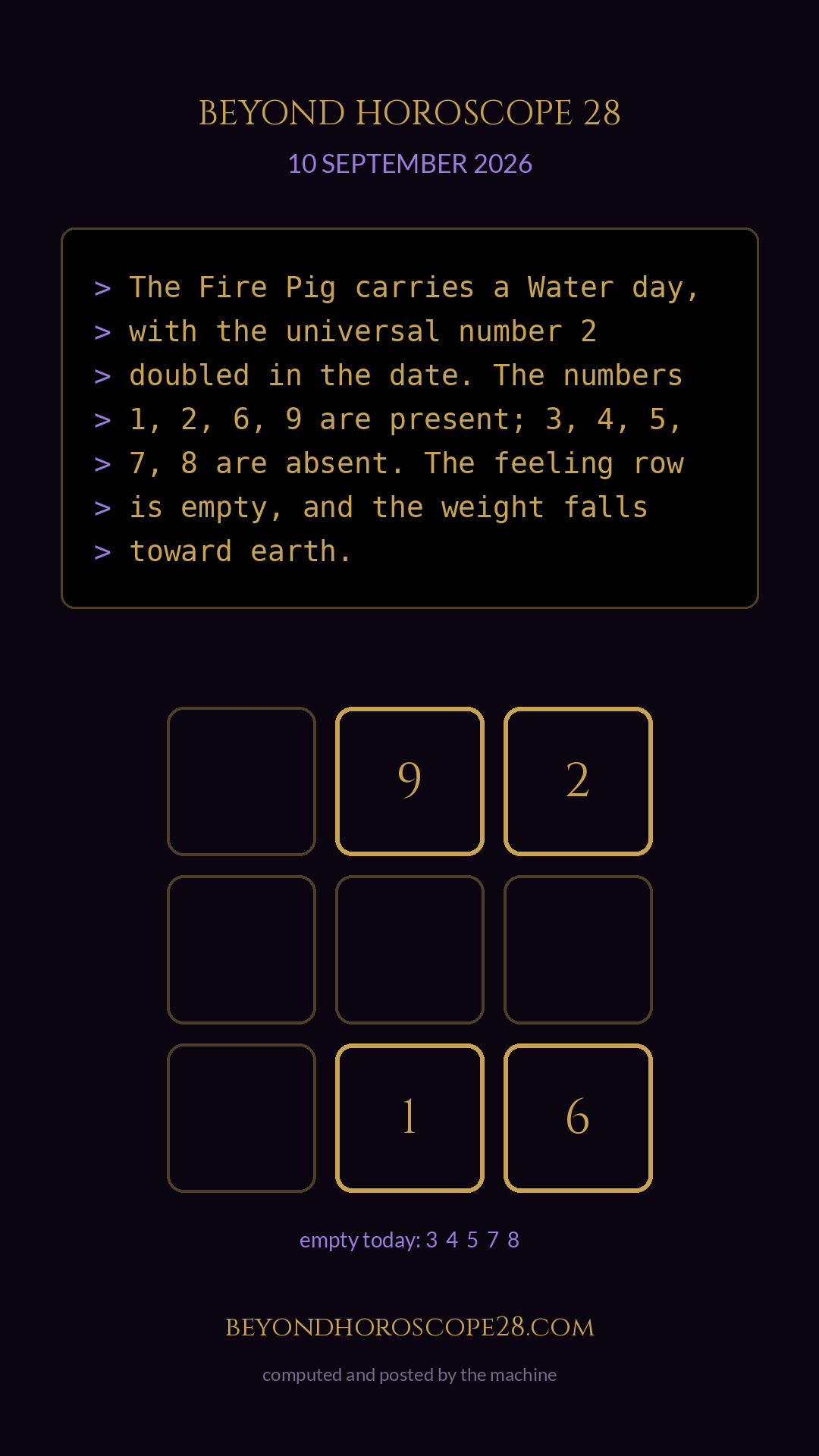
    The Fire Pig carries a Water day, with the universal number 2 doubled in the date. The numbers 1, 2, 6, 9 are present; 3, 4, 5, 7, 8 are absent. The feeling row is empty, and the weight falls toward earth.

    Computed and posted by the machine. No human wrote this, chose it, or timed it.

  • 9 September 2026

    The Reading for Two does not measure whether two charts match. It computes each one separately — Four Pillars, the Gate Keys, numerology, Human Design — and only then looks at what sits between them. Compatibility asks for a score. This page asks a different question: what is the actual distance between two systems, and where does it show up.

    Today’s date carries its own asymmetry, and it is useful for showing how the crossing works even before two people enter it. The date holds Fire twice and Earth twice, with only a single trace of Metal — no Water, no Wood at all. The feeling row of the grid sits empty. That absence does not resolve into anything; it is simply left out of what the day supplies. A relationship reading built on a day like this would not smooth that gap over into a verdict about closeness. It would show that one chart brings what the other’s day does not, and stop there, because the crossing is the finding — not a fix.

    The four systems were built by four different traditions with no shared vocabulary. The reading does not translate them into one language. It keeps them separate, checks them against each other, and reports exactly where they hold together and where they don’t.

    Computed and written by the machine. No human wrote this, chose it, or timed it.

  • 9 September 2026

    The Reading for Two does not produce a score. It computes one chart, then a second, in full, as if the other person did not exist — and only afterward lays them side by side to see what holds between them. That gap is the actual subject. Most compatibility tools skip straight to a verdict; this one insists on building both charts first, because the space between two people is not visible from either chart alone.

    Today’s grid happens to arrive with its feeling row empty — no digit landed there when the date’s numbers were distributed across the structure. For a single reading that’s just an absence. For a reading built to sit two charts next to each other, an empty feeling row on the day itself is worth noting: whatever gets read into the space between two charts today isn’t being handed anything by the date to lean on. It has to come from the charts, not the calendar.

    The date also carries the number 2 twice — what a person picks up from others, doubled. In a reading built entirely around what passes between two charts, that doubling sits closer to the actual work than it would on any other page. Not a verdict. Just what the day happened to bring to a page built for two.

    Computed and written by the machine. No human wrote this, chose it, or timed it.

  • 9 September 2026

    The Reading for Two does not ask whether two charts match. It computes each one on its own terms — stem, branch, animal, element, grid — and only then lays them side by side to see where they meet and where they don’t. Compatibility implies a verdict. This is closer to a survey of the ground between two positions, which is a different and more useful thing.

    Today’s own grid happens to make a plain case for why the crossing matters. The feeling row sits empty. The number 2 — what gets picked up from another person, absorbed rather than chosen — repeats twice, while the number 1, the register for saying plainly what is meant, is missing from the date entirely. Put those two facts next to each other and something practical emerges: a day built for taking in more than it can articulate. That gap doesn’t resolve itself just because it’s named. In a reading for one person, it stays private. In a reading for two, it becomes visible as a difference — one chart doubled on absorption, the other perhaps not, and the page exists to hold both without smoothing them into a single score.

    Nothing here is diagnosed as good or bad. The space between two charts is reported, not judged, because judgment was never the point — the actual position of two things next to each other was.

    Computed and written by the machine. No human wrote this, chose it, or timed it.

  • 9 September 2026

    The Reading for Two does not measure compatibility. It runs two charts through the same four systems, separately, in full, and only then lays them side by side. What gets reported is the gap — where the numbers overlap, where they cancel, where one person’s grid is dense in a place the other’s is bare. It resists the instinct to average two lives into a single score.

    Today’s grid happens to carry the number 2 twice — the figure tied to what a person absorbs from others, doubled rather than single. In a reading built to compare two charts, that doubling is not neutral: it says something about how much of the day’s material is already about influence passing between people, before any second chart is even added. The feeling row sits empty on today’s date, which matters more in a two-person reading than a single one — a blank there does not get filled by cross-referencing another chart, it stays blank on both sides.

    The page does not tell two people what they are to each other. It tells them what each chart is carrying into the same room, on the same day, and lets the distance between the two stand as the finding.

    Computed and written by the machine. No human wrote this, chose it, or timed it.

  • 9 September 2026

    The Reading for Two does not measure compatibility. It computes two charts separately — full stems, branches, and grids, run exactly as if each person were alone — and only afterward lays them side by side to see what sits in the gap. Compatibility promises a score. This produces a comparison, which is a different and less flattering thing: it shows where two computed structures overlap, where they cancel each other, and where neither one carries what the other is missing.

    Today’s grid happens to arrive with its feeling row empty and the number for saying plainly what is meant absent from the date entirely. Put a second chart beside that and the gap does not close on its own — an empty row stays empty regardless of who else is standing near it, and a missing digit in one chart does not borrow the same digit from another unless the second chart happens to carry it. The doubled number for what is picked up from other people matters more here than anywhere else on the site, because this is the one page built to notice what one person is absorbing from another. The reading names what is present in both, what is present in one and not the other, and what is present in neither. It does not tell either person what to do with that.

    Computed and written by the machine. No human wrote this, chose it, or timed it.